 KIDS RIDE-ON TOYS WHOLESALE
sourcing / BUYER DESK
How to Manage Two Market Variants on One Ride-On Platform
Structure a two-market ride-on RFQ with separate configuration revisions, quote comparisons, sample evidence, and replenishment approvals.
Published 2026-11-04
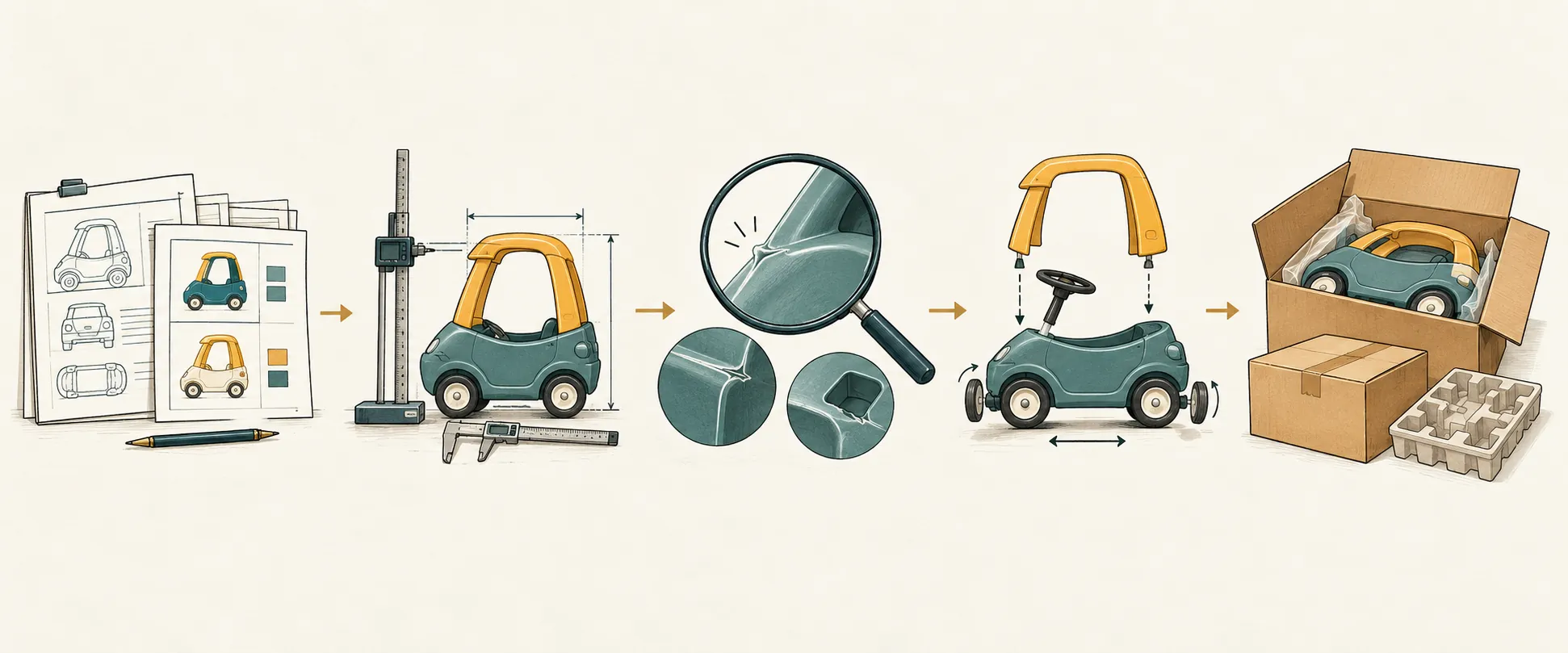
Manage two market variants under one ride-on model platform with one shared platform record and two separately revision-controlled variant records. Keep genuinely common drawings and parts in the platform record; tie each market’s electrical configuration, accessories, packaging, and document references to its own orderable variant. Require every quote, sample approval, purchase order, and replenishment request to identify both the platform revision and the market-variant revision. A shared model name alone is not enough.
Use the platform record to organize common engineering information—not to authorize substitutions between destinations. A regional quote label such as “Southeast Asia” or “Europe and US” also needs an exact destination country in the purchasing record.
Diagram: How to manage two market variants under one model platformWhich quoted products can be treated as variants of one platform?
| DLS01 electric motorcycle — Southeast Asia quote | Quoted reference: 12V system; two 6V 4.5Ah batteries; motor reference 550 × 1. Product dimensions: 115 × 38 × 70 cm; package dimensions: 72 × 41 × 47 cm; one unit per carton. Quoted features include a stepless speed-control grip, large wheels, suspension, lights, an MP3 connection, music, and Bluetooth. |
|---|---|
| DLS 09 electric motorcycle — Southeast Asia quote | Quoted system reference: 6V. Product dimensions: 85 × 42 × 58 cm; package dimensions: 58 × 27 × 39 cm; one unit per carton. Quoted features include a single battery, single drive, off-road tires, lights, a USB/MP3 connection, and music. Request separately stated battery capacity and motor specifications rather than relying on the compressed configuration string. |
| DLS-X1 electric ATV — Europe and US quote | Quoted reference: 12V system; one 12V 7Ah battery; motor reference 550 × 2. Quoted features include 2.4 GHz remote control, four-wheel independent suspension, two seats, LED lights, USB, music, and Bluetooth. The feature wording includes both dual-drive and four-wheel-drive language; require an explicit drive-layout selection in the RFQ. |
| Platform grouping decision | Keep these references separate during quote normalization. Do not use the smaller DLS 09 as the second-market equivalent of DLS01, or the DLS-X1 ATV as its Europe/US counterpart. Request the second destination configuration against the chosen base platform. |
What belongs in the shared platform record versus each market record?
Store an attribute at platform level only when both variants are approved to use the same controlled specification.
The platform record should identify the supplier’s base model, drawing revision, structural parts list, and relevant mounting interfaces. Dimensions may be shared when the same drawing applies to both variants. Keep a referenced copy of the approved platform revision rather than allowing a later master-data edit to silently alter existing approvals.
Put destination, electrical configuration, charger and plug, controller settings, selected features, labeling, instructions, packaging artwork, and document references in each market record. Some values may match across markets; they still need an explicit link to the approved specification.
Choose a separate platform record if a structural change makes the common drawings or interface assumptions inaccurate. Use a separate market-variant revision when the underlying platform remains the same but a battery, controller, accessory, label, or packaging specification changes.
How should a two-market DLS01 RFQ worksheet be completed?
| Record identity and revision | Create one DLS01 platform record and two child records: Variant A for the named Southeast Asian destination and Variant B for the United States. Assign each record a controlled revision. Require the supplier’s exact item identifier, quote number, quote date, and configuration reference on each child record. |
|---|---|
| Shared-platform target | Request the same base structure and mounting interfaces for both variants. Use the quoted 115 × 38 × 70 cm product dimensions as the initial comparison target. Require drawing references and an itemized list of structural differences before accepting either configuration as part of the shared platform. |
| Electrical target versus supplier offer | Variant A starting reference: 12V system, two 6V 4.5Ah batteries, and motor reference 550 × 1. For Variant B, request this baseline or a separately priced, explicitly described alternative. Require the supplier to state battery specifications, wiring arrangement, motor identification, controller, and charger for each variant. Do not interpret 550 as a wattage rating. |
| Feature target versus supplier offer | Use the quoted DLS01 feature set as the initial RFQ target: stepless speed-control grip, large wheels, suspension, lights, MP3 connection, music, and Bluetooth. Ask the supplier to identify included, omitted, and optional functions separately for each destination. |
| Packaging and destination target | Variant A quotation reference: 72 × 41 × 47 cm package and one unit per carton. Request a separate packing specification, charger/plug selection, instruction version, label set, and artwork revision for each destination. Retain the quoted regional label as a reference, not as the destination specification. |
| Commercial comparison basis | Request separate prices at the same stated quantities, currency, and accessory scope. Record each variant’s minimum order conditions, option charges, sample charges, and quote validity. Price any proposed deviation separately so that a lower specification is not mistaken for a lower price on the same configuration. |
| Evidence and observation fields | For each consequential attribute, provide spaces for the specified target, supplier’s quoted offer, sample or document identity, observed result, review method, reviewer, and date. Keep observations separate from the requested specification. |
| RFQ-stage decision | Issue the inquiry as two separately priced destination lines under a proposed common platform. Do not authorize production or cross-market substitution through the RFQ. Route any structural or electrical alternative for review before selecting a sample configuration. |
| Responsibility and closure | The buyer’s product owner approves the RFQ revision and records their name and date before issue. Assign each supplier clarification to an owner and due date. Close it with the supplier response, the buyer’s disposition, and the resulting configuration revision. |
How do you compare quotes without treating claims as proof?
Compare the supplier’s offer against each variant’s specified target, and attach an evidence status to each consequential attribute rather than to the product as a whole.
“Quoted” means the supplier states the feature or specification. “Observed” means an identified sample, photograph, or video shows a particular characteristic under recorded conditions. “Verified” means a defined check supports that specific attribute, with the result and reviewer recorded. Verification of one feature does not verify the complete configuration.
For example, Bluetooth playback demonstrated on an identified DLS01 sample supports an observation about that sample’s audio function. It does not establish battery capacity, motor specification, or destination suitability. Likewise, a battery label photograph records the marking; it is not a capacity test.
Align technical scope before choosing on price. If one quote changes the battery, omits Bluetooth, or includes a different charger, retain it as an alternative configuration until the difference is accepted. Do not average the two market prices or approve one variant by reference to the other.
Keep destination-document review attached to the relevant configuration. Ask the responsible reviewer to check product identification, tested construction, accessories, and the scope of applicable documents. Commercial sample checks are not substitutes for safety testing, and a combined “Europe and US” quotation label is not a combined approval.
What must the approval record contain before replenishment?
| Identity and revision | Record the platform identifier and revision; market-variant identifier and revision; exact destination; supplier item identifier; configuration reference; purchase-order line; and sample or lot identity. |
|---|---|
| Specified target versus observation | Place the approved electrical configuration, selected features, dimensions, charger, labels, and packaging references beside the corresponding inspection or document-review results. Identify the sample, method, date, and evidence reference for each check. |
| Decision and conditions | Record approve, approve with stated conditions, or hold. State whether the decision authorizes a sample purchase, production, or shipment. Give each condition a specific acceptance criterion rather than writing “confirm later.” |
| Responsible approvers and date | Name the buyer’s release authority and record the decision date. Identify the technical, quality, and destination-document reviewers responsible for the checks within their respective scopes. |
| Follow-up closure | Assign each open condition an owner and due date. Record the corrective action or clarification, supporting result, closure approver, and closure date before releasing the affected stage. |
| Replenishment comparison | Require supplier confirmation against the exact approved revisions and a declared-change list. Compare relevant component identifications, functions, and packaging against the retained approved references using a risk-based inspection plan. |
When should a change trigger a new variant revision?
Create a new variant revision whenever an accepted change alters an approved market-specific specification, and revise the platform record when the accepted change alters shared structure or interfaces.
A proposed charger substitution belongs to the affected destination record. A change to the common frame or battery mounting interface requires review of both variants. Keep the earlier approved revision available for open orders; do not overwrite it with the replacement.
Put this instruction on replenishment orders: “Supply the identified platform and market-variant revisions. Declare proposed component, firmware, accessory, labeling, or packaging changes before implementation. Obtain written approval for any deviation from the referenced specification.”
The practical rule is simple: share the platform information that is genuinely common, but release and replenish each market configuration on its own approved record.
Continue the buying conversation
Compare the ride-on range, packing references and product files before requesting a quotation.