 KIDS RIDE-ON TOYS WHOLESALE
sourcing / BUYER DESK
Ride-On Sample Inspection: When to Approve or Hold
Inspect a ride-on sample against the written specification, record discrepancies, and decide whether to approve, correct, or hold without inferring performance.
Published 2026-10-30
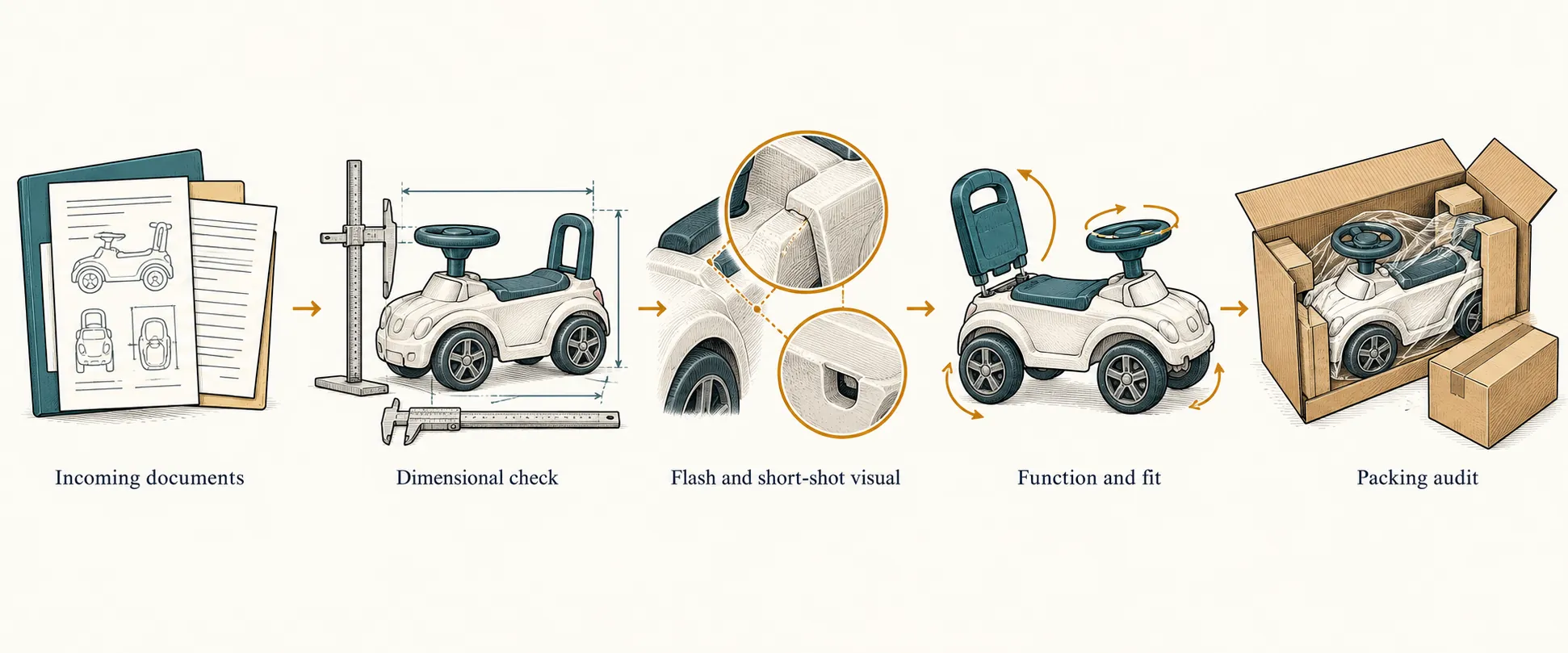
Inspect a ride-on sample against the agreed written specification and design requirements, then approve only the characteristics your inspection actually establishes. Record component markings, dimensions, assembly, finish, packaging and observed operation separately from supplier claims. A motor turning does not establish speed, load capacity, range, durability or safety. Use the worksheet below to decide whether to approve the sample within a defined scope, request correction or hold approval; retain an approved production reference only after that decision.
Diagram: How to inspect a ride-on sample without inferring performanceWhat should you compare the first ride-on sample against?
Compare the first sample with the agreed specification, drawings, component list and packaging requirements—not with an approved sample that does not yet exist. Resolve ambiguous quotation shorthand before using it as an acceptance criterion.
The electric motorcycle example has a quoted DLS01 configuration with a 12V system reference, one 12V7AH battery reference and one motor reference written as 550. Treat these as quoted identifiers to verify. The motor shorthand does not establish wattage, and the battery reference does not establish measured capacity or runtime.
For the quoted size entry, agree the units, dimension order, assembled condition and measurement points before deciding whether a measurement matches. Put any acceptance tolerances in the buyer's inspection instructions; they are purchasing criteria, not safety standards.
The quotation's Europe/US variant description identifies a commercial configuration, not approval for either destination. Keep destination-specific document review separate from the physical sample decision.
Ride-on sample inspection record
| Quoted product identity | Electric Motorcycle Ride-On; internal item reference: ROT-353495; supplier model reference: DLS01. Configuration shorthand: (12V), 12V7AH × 1, 550 × 1; Europe/US quotation variant. |
|---|---|
| Quoted size and packing | Size entry: 115 × 38 × 70. Packing: carton. Quantity: 1 unit per carton. Confirm size units and measurement convention in the agreed specification before judging dimensional conformity. |
| Inspection identity and revision | Enter inspection record ID and revision, sample tag, receipt date, inspection date, inspector, quotation revision, specification/drawing revision and intended destination variant. |
| Supporting record references | Enter component-list revision, assembly-instruction revision, packaging/artwork revision, media file references and supporting document identifiers. Link manufacturer model references to the buyer's item reference. |
| Approval and closure | Enter decision, approval scope, unresolved conditions, responsible approver and approval date. For each follow-up, enter the issue owner, due date, correction evidence, recheck result, closure approver and closure date. |
Ride-on sample inspection worksheet
| 1. Sample identity and configuration | Quoted reference: DLS01, 12V system, battery reference 12V7AH × 1, motor reference 550 × 1. Observed sample: transcribe accessible model and component markings; record component counts without dismantling beyond authorized access. Media check: compare identifiers and visible configuration. Carton check: compare item and variant markings. Document check: reconcile the quote, component list and sample identification. Failure signal / next action: conflicting or unlinked identifiers require clarification before configuration approval. |
|---|---|
| 2. Dimensions | Quoted reference: 115 × 38 × 70, interpreted through the agreed measurement specification. Observed sample: enter measured values, units, assembly state, measurement points and tool used. Media check: verify the pictured assembly state. Carton check: record whether parts arrive assembled or detached. Document check: compare the dimensioned drawing and agreed tolerances. Failure signal / next action: an unexplained difference requires remeasurement, correction or a formally accepted specification revision. |
| 3. Materials and finish | Quoted reference: use the agreed component/material list and finish requirements. Observed sample: inspect body panels, seat, wheels, grips and footrests for visible cracks, flash, scratches, uneven coating, decal errors and inconsistent fit. Media check: compare colors, textures and graphics. Carton check: inspect protection at contact points. Document check: link material declarations to the specified components. Failure signal / next action: record the location and extent of defects; request correction. Appearance or touch alone does not identify polymer composition. |
| 4. Assembly and mechanical movement | Quoted reference: agreed assembly drawing and instructions. Observed sample: inspect wheel attachment, handlebars, seat mounting, footrests, visible fasteners, alignment and cable routing; note binding or unintended looseness during permitted movement. Media check: compare fitted parts and accessories. Carton check: reconcile loose parts with the packing list. Document check: verify assembly steps and hardware references. Failure signal / next action: loose mounting, missing hardware or trapped wiring warrants stopping the affected check and requesting correction. |
| 5. Limited functional observation | Quoted reference: only the controls and functions listed in the agreed specification. Observed sample: record the control used and response observed, under documented conditions; check forward/reverse, lights or sound only when specified and present. Media check: distinguish supplier demonstrations from your own observations. Carton check: reconcile included accessories with the packing list. Document check: use the operating instructions and agreed inspection procedure. Failure signal / next action: unexpected movement, failure to stop or abnormal electrical behavior means stop operation and hold the affected approval. |
| 6. Packaging and included contents | Quoted reference: 1 unit per carton plus agreed packing list and artwork. Observed sample: count the ride-on, loose components, accessories and instructions. Media check: compare packaging photographs with the delivered arrangement. Carton check: inspect damage, internal supports, abrasion points, orientation and printed identifiers against the packaging revision. Document check: reconcile the packing list and artwork. Failure signal / next action: incorrect count, omitted contents, transport damage or artwork mismatch requires a recorded packaging correction and recheck. |
How should you check media and supporting documents?
Use media and documents to corroborate identity and construction, not to replace the physical sample inspection. Label each photograph or video by its source and the sample or revision it represents; a supplier video is evidence of the demonstration shown, not proof that your sample has the same configuration or performance.
Compare body shape, wheels, controls, seat, decals, component labels and included accessories. A difference is a reconciliation task: establish whether it reflects another variant, an older revision or an actual sample discrepancy. A missing photograph alone does not invalidate measurements, written observations or other valid inspection evidence.
For test reports, compare the identified model, photographs, materials and components with the sample and agreed construction. Watchdog Compliance recommends checking these details rather than assuming a report for a similar-looking toy covers the ordered product. Watchdog Compliance
A different commercial item code is not automatically a coverage failure if a documented model mapping establishes the connection. Equally, the same name is not enough when the construction differs. Record the report identifier and the basis for the connection, and refer coverage questions to the responsible technical reviewer. Neither document presence nor this hand inspection establishes regulatory safety or age suitability.
What does a battery-label check actually establish?
A battery-label check establishes the markings you can read and the installation details you can observe—not the battery's measured capacity or the ride-on's runtime.
For the quoted 12V7AH × 1 reference, transcribe the label exactly and record the visible quantity through authorized access. For example, if a label reads only 12V, enter that text rather than marking the entire 12V7AH requirement as matched. Request identification linking the installed battery to the agreed component specification; do not infer 7Ah from the quotation.
If the markings match, close the identification check within that scope. If they conflict, request a corrected component or review a proposed specification change before approval. A supplier explanation can resolve an identity question, but it is not a measured performance result.
Before any powered observation, follow the manufacturer's instructions and the agreed inspection procedure. Do not use a child or an improvised rider load to explore capability. Stop if you find damaged wiring, battery swelling or insecure assembly; route the issue for technical review rather than improvising a safety test.
When should you approve, request correction or hold?
| Approve the sample within scope | Use when the inspected characteristics meet the agreed specification and required review conditions are closed. Record precisely what is approved, the specification revision and the approver/date. Do not describe this decision as proof of speed, range, load capacity, durability, age suitability or regulatory compliance. |
|---|---|
| Request correction or clarification | Use for a defined discrepancy such as a decal mismatch, packing-list omission or component-identity question. Record target versus observation, issue owner and required evidence. Recheck the correction and record closure; require a revised sample when the change cannot be adequately verified through documents or media. |
| Hold the affected approval | Use when the sample cannot be linked to the agreed configuration, a consequential discrepancy remains unresolved or powered observation must stop. Specify the blocked decision and the evidence or correction needed to resume. A hold is not a finding that the supplier is dishonest or that the product necessarily fails a laboratory test. |
What becomes the reference for bulk inspection?
After sample approval, tag and retain the approved production reference together with its specification revision, inspection record, packaging reference and accepted changes. Do not designate the first arrival as approved merely because it was received or photographed.
Bulk inspection is the next stage: compare production units with the written specification, approved reference, drawings, packaging requirements and change records. The retained sample complements those records; it is not the only valid basis for comparison.
Require proposed component, material, design or process changes to be documented and reviewed before acceptance. Watchdog Compliance also recommends reassessing whether existing testing continues to support the product after such changes; that is a technical evidence review, not an automatic demand for a new report for every batch or internal item code. Watchdog Compliance
The approval record supports traceability. It does not, by itself, prevent or reveal an undisclosed production change.
Continue the buying conversation
Compare the ride-on range, packing references and product files before requesting a quotation.