 KIDS RIDE-ON TOYS WHOLESALE
sourcing / BUYER DESK
Southeast Asia Ride-Ons: Approve Battery/Motor Changes
Document electric motorcycle ride-on battery or motor changes with a revision worksheet, document owners, sample checks, and release decisions.
Published 2026-11-03
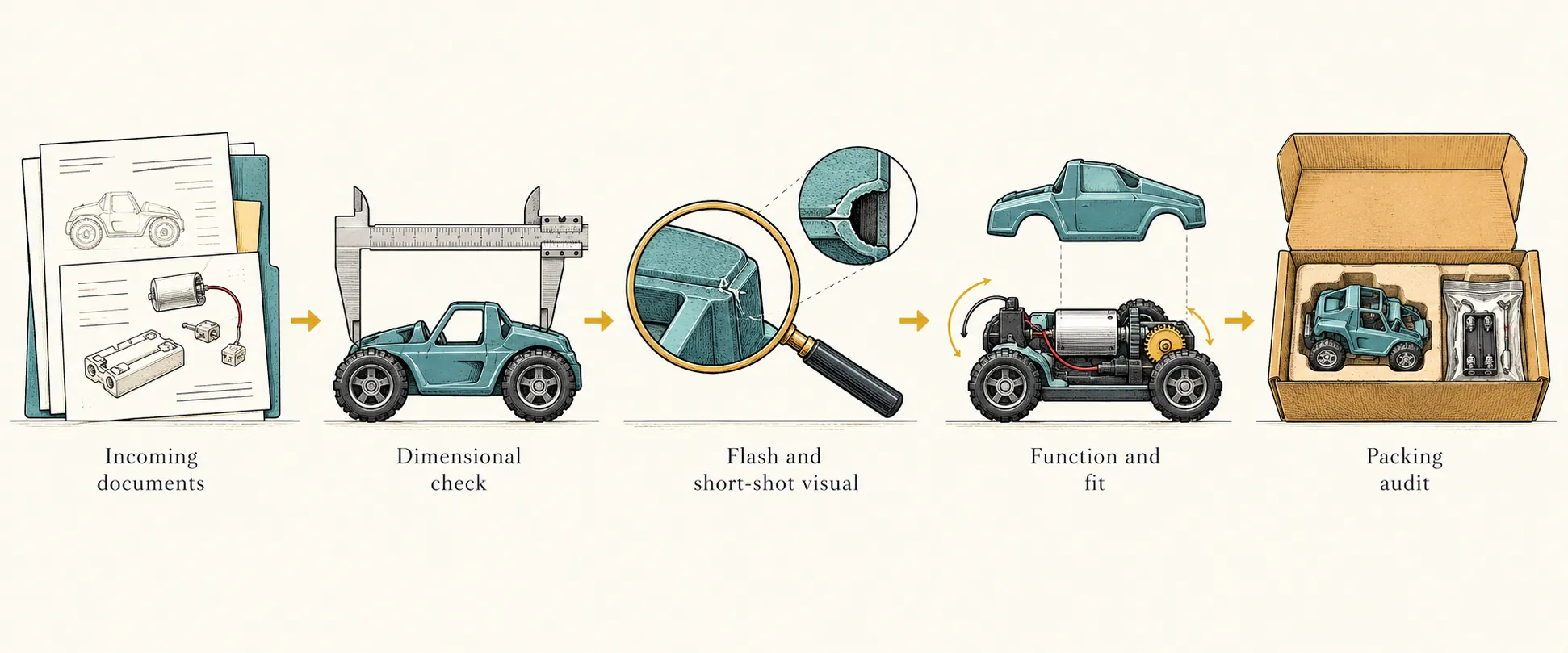
Document a changed battery or motor package in a revision-controlled change record that connects the electric motorcycle ride-on’s quoted configuration, proposed replacement, sample evidence, and approval decision. For the Southeast Asia quote variant, identify the actual destination country before approving the change. Keep supplier statements separate from observations, reconcile the affected specifications and packaging, and release the revised order only against a named configuration revision. A shared product name or the same nominal voltage is not sufficient approval evidence.
Diagram: How to document a changed battery or motor packageWhich quoted configuration should anchor the change record?
Anchor the record to the exact supplier configuration reference, not merely to the motorcycle’s appearance or internal item number. The electric motorcycle reference used here is DLS01 (12V) 6V4.5Ah × 2, 550 × 1, identified in the quotation as the Southeast Asia variant.
That reference describes a quoted 12V system, two batteries referenced as 6V4.5Ah each, and one motor referenced as 550. It does not establish battery chemistry, wiring arrangement, motor wattage, charger compatibility, or measured performance. In particular, do not rewrite “550” as “550W.”
The quoted features include a variable-speed twist grip, large wheels, suspension, lights, an MP3 connection, music, Bluetooth, and two batteries with a single drive. These remain supplier statements until the relevant construction or function has been checked.
There is a useful catalog contrast: the DLS-X1 electric ATV carries a Europe and US quote reference of 12V7Ah × 1 and 550 × 2. Both references say 12V, but they describe different battery and motor packages on different vehicles. The ATV reference is not an approved replacement specification for the motorcycle, and its market label is not evidence of destination-market acceptance.
What belongs in the SKU-level battery/motor change worksheet?
| Product identity | Electric motorcycle ride-on; internal SKU: ROT-353494; supplier model family: DLS01. Carry both identifiers in the change record and document cross-reference. |
|---|---|
| Market and destination | Quoted variant: Southeast Asia. Record the destination country, buyer/importer identity, and affected order or replenishment reference before approval. |
| Record identity and revision | Assign a change-record number, revision, issue date, requester, and reason for change. Identify whether the request is supplier-initiated or buyer-requested; a proposal is not an approved revision. |
| Old configuration reference | Quoted baseline: DLS01 (12V) 6V4.5Ah × 2, 550 × 1, Southeast Asia variant. Attach the dated quotation and identify whether it matches the existing approved order. |
| Proposed configuration reference | Obtain a complete revised reference from the supplier. Record each changed battery, motor, charger, controller, connector, or wiring item separately; explicitly identify retained components. |
| Battery: target versus observation | Quoted baseline: two batteries referenced as 6V4.5Ah each. Target: enter proposed quantity, nominal voltage, Ah rating, chemistry, part number, dimensions, terminals, mounting, and connection arrangement. Observation: enter label photographs, accessible count, installation photographs, observer, sample ID, and check date. |
| Motor: target versus observation | Quoted baseline: 550 × 1, single drive. Target: specify motor manufacturer/part reference, quantity, rated voltage, documented ratings, gearbox interface, and mounting. Observation: record accessible markings and installed quantity separately from supplier specifications. |
| Related electrical components | Request the charger input/output ratings, plug and charging connector, polarity, controller reference, wiring diagram, and protective components relevant to the proposed change. Record the supplier’s compatibility assessment and the reviewer’s disposition. |
| Physical identity cross-check | Quoted product dimensions: 115 × 38 × 70 cm; quoted package dimensions: 72 × 41 × 47 cm; quoted carton quantity: one unit. Compare the revised sample and packaging with these references. Matching exterior dimensions do not verify the internal electrical package. |
| Sample and evidence identity | Record sample ID, configuration revision, receipt/check dates, photo or video filenames, component specification references, reviewer, and any measurements with their method. Keep supplier media and buyer or inspection observations distinguishable. |
| Affected-document register | List each affected document’s identifier, revision, owner, status, and next action. Use clear statuses such as old revision, updated, pending, or reviewed—no change needed. |
| Approval and release authority | Enter approve, approve with conditions, or reject; name the exact configuration revision covered. Record the technical approver, procurement authorization where applicable, approval date, and separate production or shipment release status. |
| Conditions and closure | For every condition, record the required action, responsible owner, due date, release gate, closure evidence reference, closing reviewer, and actual closure date. Carry unresolved items into the next review rather than deleting them from the record. |
| Change effectivity | Identify the first affected PO, production lot, or other traceable production boundary. Record how earlier-version stock and revised stock will be distinguished, including any approved service-parts differences. |
How should supplier claims be separated from sample evidence?
Record what the supplier says in one field and what the reviewer actually observes in another; neither a quotation nor a photograph establishes every characteristic of the installed package.
For the motorcycle baseline, a useful reconciliation reads: specified target—two batteries referenced as 6V4.5Ah each; observed evidence—photographs showing the accessible battery labels, count, mounting, and connections; conclusion—whether those observations match the specified fields. A close-up of one battery label does not establish that two batteries are installed. A motor photograph may show a marking without proving its electrical rating.
Give the reviewer a defined inspection scope. Have a suitably qualified person check accessible components, record whether markings were readable, and identify any installation details that could not be observed without further access. Keep measurements, nameplate readings, supplier documents, and functional checks individually attributable.
Review the connected package, not just the replacement component. Ask the supplier to explain the effects on charging, wiring, controller compatibility, mounting, and any advertised operation. A brief demonstration that the wheels turn is a functional observation, not a safety assessment or evidence of speed, range, or load capability.
Which documents are needed before the PO and before shipment?
| Supplier change notice and revised quotation — before PO or amendment | Owner: supplier sales with engineering input. Fields: product identifiers, destination variant, old/new configuration references, reason, affected components, price or timing changes, exclusions, and proposed effectivity. Mismatch consequence: the buyer may approve a technical change while ordering or paying against different commercial terms. |
|---|---|
| Controlled configuration sheet, component list, and wiring reference — before approval | Owner: supplier engineering; reviewed by the buyer’s technical lead. Fields: revision, battery and motor identifiers/counts/ratings, chemistry, charger, controller, connectors, polarity, mounting, wiring arrangement, and retained parts. Mismatch consequence: the quote, assembly instruction, and actual component combination may describe different packages. |
| Sample evidence record — before technical approval | Owner: buyer QA or appointed inspection reviewer. Fields: sample ID, proposed revision, supplier claims, observed markings and construction, photographs, methods, results, discrepancies, reviewer, and date. Mismatch consequence: approval may be attributed to a sample that does not represent the proposed production configuration. |
| Packaging, label, and instruction revision set — drafts before PO; released files before use | Owner: supplier artwork/manual coordinator with buyer review. Fields: file IDs, revision dates, product/configuration references, electrical statements, charging and assembly instructions, and destination-specific content selected through the market review. Mismatch consequence: the supplied vehicle and customer-facing instructions may describe different battery or charging arrangements. |
| Technical-document coverage review — before change approval | Owner: buyer’s technical or compliance reviewer, with supplier or laboratory input as appropriate. Fields: destination country, report/document identifiers, tested sample and construction, changed components, coverage assessment, applicable retest duties, and retailer policies. Mismatch consequence: the purchasing decision may rely on evidence covering a different construction or scope. |
| PO or PO amendment — at commercial commitment | Owner: buyer procurement; acknowledged by supplier. Fields: item identity, approved configuration revision, controlled attachments, quantities, agreed commercial changes, approval conditions, substitution controls, and effectivity. Mismatch consequence: the approved sample configuration may not be the configuration actually ordered. |
| Production inspection record — after production, before release | Owner: supplier QA and/or appointed inspector. Fields: PO, lot, approved revision, inspected units, component markings/counts, installation observations, checklist results, deviations, and disposition. Mismatch consequence: there is no clear record connecting the inspected production to the approved configuration. |
| Shipment document set — at shipment preparation | Owner: supplier shipping/documentation team; checked by buyer logistics. Fields: final invoice and packing list, PO and item references, shipped quantities, cartons, actual shipment weights, lot references, and a cross-reference to the approved configuration and inspection record. Mismatch consequence: the shipment cannot be readily reconciled to the approved order and inspected goods. Full electrical details can remain in the linked controlled specification. |
Does a changed battery or motor automatically require a new report?
Do not decide report coverage from the changed part name, internal SKU, or report date alone; obtain a construction-specific review for the actual destination country.
Give the reviewer the old and proposed configuration sheets, component specifications, wiring changes, sample evidence, and relevant existing reports. Ask for a written conclusion identifying what remains covered, what further evaluation is needed, and the basis for that conclusion. Assess applicable retest duties and buyer or retailer policies separately.
The Southeast Asia quotation label is not a country-specific document assessment. Equally, a later batch or a different internal item reference is not, by itself, a sufficient basis for concluding that every report must be replaced. Preserve the link between the tested construction, the proposed change, and the reviewer’s decision.
When should the buyer approve, conditionally approve, or reject the change?
| Approve | Use when the defined replacement is acceptable, relevant sample observations match the target, the technical-document review is resolved, and affected documents are reconciled for the release stage. Record the configuration revision, authorized scope, named approver, date, and effectivity. |
|---|---|
| Approve with conditions | Use when the change is acceptable in principle but named actions remain. For example, allow packaging preparation while withholding production release until a specified sample discrepancy is resolved. Assign each condition an owner, due date, required evidence, closing reviewer, and release gate. |
| Reject | Use when the proposed package does not meet the buyer’s specified requirements or the reviewed configuration is unacceptable. Record the reason and next instruction: retain the previously approved package, revise the proposal, or cancel the affected change. Rejecting a proposal is not a finding of supplier dishonesty. |
What must be closed before replenishment is released?
Release replenishment against the approved revision only after conditions assigned to that release gate are closed with evidence and a named reviewer’s authorization.
Check the new order against the change record’s effectivity boundary, supplier acknowledgment, current controlled specification, packaging release, and inspection instructions. Where earlier and revised units coexist, identify how the shipment and service records distinguish them.
The change record supports traceability; it cannot by itself reveal an undisclosed substitution. Keep the production checks tied to the characteristics that changed, retain any unresolved conditions visibly, and record the final release authority and date.
Continue the buying conversation
Compare the ride-on range, packing references and product files before requesting a quotation.