 KIDS RIDE-ON TOYS WHOLESALE
sourcing / BUYER DESK
How to Set the Approval Gate for a Ride-On Bulk Order
Define approve, hold and reject criteria for a ride-on bulk order, with a practical record linking the quote, sample, market variant and documents.
Published 2026-11-08
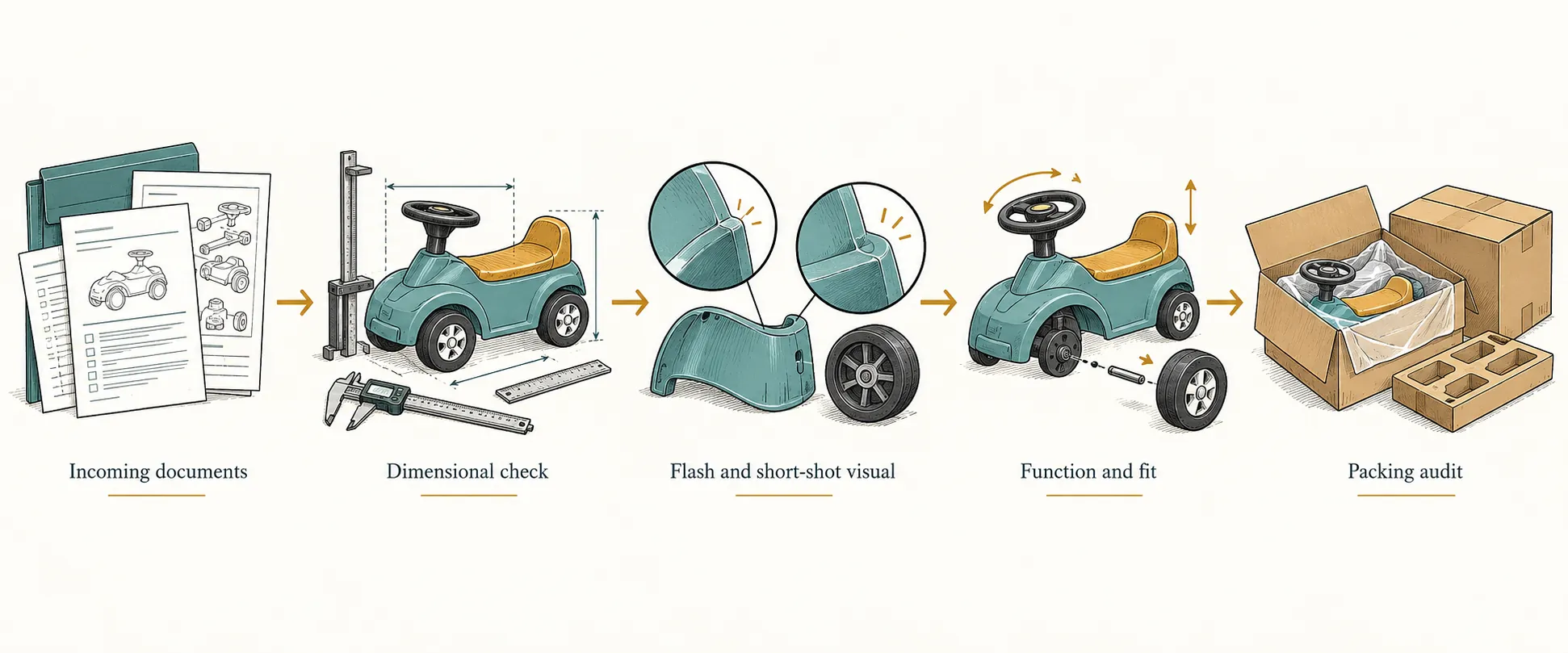
Define the approval gate before a ride-on bulk order as a signed release decision on one identified order revision—not a general approval of the supplier or product family. Tie that decision to the SKU, destination market, quoted configuration, sample revision, packaging revision and document set. Approve when the agreed release requirements are met; hold when a blocking condition remains open; reject a configuration that does not meet the agreed requirements. Record who decided, when, and what evidence supports the decision.
Diagram: How to define the approval gate before a ride-on bulk orderWhat exactly should the approval cover?
The approval should cover the specific order package that purchasing is authorized to release, including its configuration and supporting evidence.
Define the commitment being controlled: issuing the purchase order, paying a deposit or authorizing bulk production. Put the gate before that commitment. A pre-order approval is not a substitute for any later production or shipment checks specified in the purchasing agreement.
Name the actual destination country or countries separately from the supplier’s market-variant label. “Southeast Asia” and “Europe and US” identify quotation variants; neither label establishes suitability for every country within those regions.
A useful RFQ instruction is: “Quote the identified configuration and list any proposed deviations separately. Reference the sample, packaging and document revisions intended for this order. Do not substitute components or features without written change approval.” This makes the requested baseline explicit without treating the supplier’s response as verified proof.
Why must each ride-on configuration have its own approval?
| DLS01 electric motorcycle — catalog identity ROT-353494 | Southeast Asia quote variant. Configuration reference: DLS01 (12V), 6V4.5AH*2, 550*1. Quoted product size: 115 × 38 × 70 cm; package size: 72 × 41 × 47 cm; carton quantity: 1. Quoted features include a variable-speed twist grip, large wheels, suspension, lights, MP3 input, music and Bluetooth, with dual batteries and single drive. Use this configuration as its own approval baseline. |
|---|---|
| DLS 09 electric motorcycle — catalog identity ROT-353501 | Southeast Asia quote variant with a 6V system reference. Quoted product size: 85 × 42 × 58 cm; carton quantity: 1. The feature statement lists a single battery and single drive, off-road tires, lights, USB/MP3 input and music. Do not carry over the larger motorcycle’s sample approval merely because both are electric motorcycles. |
| DLS-X1 electric ATV — catalog identity ROT-353505 | Europe and US quote variant. Configuration reference: DLS-X1 (12V), 12V7AH*1, 550*2. Quoted product size: 135 × 93 × 82 cm; carton quantity: 1. The feature statement includes 2.4 GHz remote control, two seats and independent suspension, but also contains dual-drive/four-wheel-drive wording. Require an unambiguous drive specification before approving that configuration. |
How should quoted claims, observations and requirements be separated?
Keep supplier statements, buyer observations and acceptance requirements in separate fields so that a quoted feature cannot silently become a verified result.
For the DLS01 motorcycle, “Bluetooth” is a quoted supplier statement. A buyer observation would identify the sample revision, inspection date and result of a defined pairing and playback check. The buyer requirement should state the agreed function and acceptance criterion. A quotation alone does not satisfy that criterion.
Apply the same discipline to physical references. Record 115 × 38 × 70 cm as the quoted product size, then specify how the assembled sample will be measured and what dimensional acceptance limits the buyer has agreed. Do not invent a tolerance after inspecting the sample.
Photos and videos can support visible observations when linked to an identified sample. They do not by themselves establish internal battery configuration, sustained operation or document applicability. Commercial sample checks also do not replace applicable safety testing.
Treat an outstanding document as an open condition with an owner and closure requirement—not as proof that the product fails. If the document is required for release under the buyer’s gate, keep the order on hold until that condition is resolved.
What belongs in the one-page ride-on approval record?
| Record identity and revision | Assign a gate-record identifier and revision. Link the RFQ or proposed purchase order, supplier identity, order quantity and quote revision/date so the signature covers one defined commercial package. |
|---|---|
| Product identity | For the worked baseline: Electric Motorcycle Ride-On; SKU ROT-353494; supplier model DLS01. Record both the buyer’s item identifier and supplier reference. |
| Destination and quotation variant | Record the actual destination country or countries. Retain “Southeast Asia quote variant” as the quotation label, separately from the destination. |
| Configuration target | Starting reference: DLS01 (12V), 6V4.5AH*2, 550*1. Attach the agreed component and feature specification, including battery, motor, controls and supplied accessories. List accepted deviations explicitly. |
| Sample identity | Enter the physical sample identifier, revision, receipt date and review date. Link photographs, component-label records and inspection notes to that same sample. |
| Packaging and instruction revision | Enter the carton artwork, label and instruction revisions. Starting quotation references: package size 72 × 41 × 47 cm and carton quantity 1. Record the reviewed packing arrangement and measurements separately. |
| Specified target versus observation | For each release requirement, record the target, check method, actual observation, evidence reference and reviewer. Include configuration identity, agreed functions, product dimensions and packing checks relevant to the order. |
| Document set and review | Index the agreed specifications, inspection records, applicable reports and destination-specific documents by identifier and revision. Have the designated technical or compliance reviewer record whether their scope matches the ordered construction and destination. |
| Open conditions | Give each condition an identifier, description, named owner, due date, closure test and release-blocking status. State exactly what evidence will close it. |
| Reviewer and approver responsibility | Name the purchasing owner, technical or compliance reviewers, and final release authority. Reviewers sign their respective findings; the authorized approver signs the order decision. |
| Decision and date | Record approve, approve with conditions, hold or reject, with the approver’s name, decision date and authorized commitment. Explain any rejection or limitation. |
| Follow-up closure | For every condition, record the closure evidence, closing reviewer and date. Where release was blocked, record the subsequent authorization before the controlled commitment occurs. |
When should the buyer approve, hold or reject the order?
Approve only when all release-blocking requirements are satisfied; use hold for resolvable open conditions and reject when the proposed configuration is unacceptable against the agreed specification.
“Approve with conditions” should never mean “release now and clarify the essential configuration later.” Use it only when each remaining condition has an owner, deadline and closure test, and the approver explicitly identifies what commitment is permitted. If a condition must close before bulk-order commitment, the record must not authorize that commitment yet.
Consider a bounded example: the RFQ calls for the DLS01 motorcycle configuration, but the revised quotation proposes the DLS 09 motorcycle. The comparison shows a different system-voltage reference and product size. Do not approve it as an equivalent replacement on the strength of the shared motorcycle description. Hold the proposed revision while the buyer evaluates the alternative against the requirements; approve it only under a revised, reviewed baseline, or reject the substitution.
For the DLS-X1 ATV, unresolved dual-drive/four-wheel-drive wording is a configuration question. If drive arrangement is a release requirement, keep that condition open until the agreed specification and reviewed evidence resolve it. An attractive feature list is not a closure record.
Which changes require the approval gate to reopen?
Reopen the gate whenever a change affects the approved product identity, configuration, sample, packaging, destination or supporting document scope.
Compare a revised quote against the configuration baseline to identify declared quote-to-sample differences. Check the destination and variant fields when the intended market changes. Review the packaging revision when labels, instructions or packing arrangements change. A new SKU or sample revision requires a fresh decision rather than a copied signature.
Preserve the earlier approval as history, mark the affected revision as superseded, and identify which checks need repeating. Unchanged evidence may remain valid when its coverage still matches the revised order; a new internal item code alone does not automatically require every test to be repeated.
The record supports traceability and disciplined release. It does not independently reveal an undisclosed component substitution or prevent defects. Its practical value is narrower and useful: purchasing can see exactly what was approved, which conditions remain open, and who has authority to release the order.
Continue the buying conversation
Compare the ride-on range, packing references and product files before requesting a quotation.