 KIDS RIDE-ON TOYS WHOLESALE
ranking / BUYER DESK
Drift Ride-On Cars vs Go-Karts: Which to Spec for Retail
Compare drift ride-on cars and go-karts for feature-led channels: use concept, quote evidence, packing and buyer risk. A spec and RFQ worksheet for importers.
Published 2026-10-22
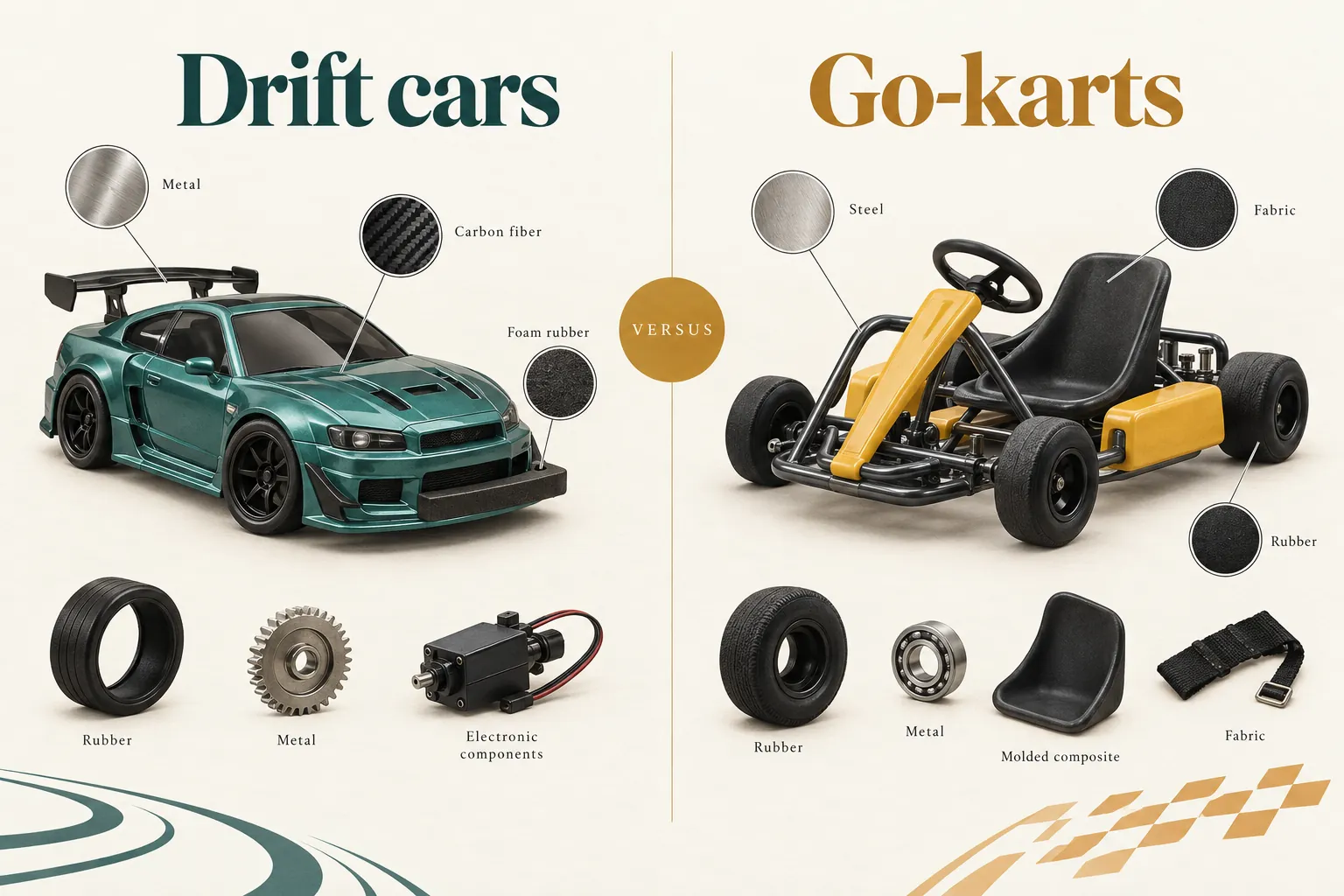
For a feature-led toy channel, spec the drift ride-on car when the shelf story is sideways slide, LED light shows and a parent-facing remote — it is the lower-commitment, higher-turns SKU. Spec the go-kart when the story is motorsport identity, bigger presence and a higher ticket that justifies the space. In drift ride on car wholesale sourcing, the deciding variables are not the feature list; they are quoted configuration, carton economics, and which claims you can actually put on a box.
This is a buyer worksheet, not a parent guide. Treat every feature string and configuration reference in a quotation as a supplier claim until a signed sample confirms it. Below: a comparison table, the quote-evidence boundary, a packing and MOQ check, and a sign-off checklist you can attach to an RFQ.
Diagram: Drift cars versus go-karts for feature-led toy channelsDrift car vs go-kart: decision criteria for a feature-led assortment
| Use concept (quoted feature input) | Drift car: slide/drift play, simulated foot throttle and brake, multifunction center console, LED front/rear lighting, music/Bluetooth, USB port, 2.4G remote, five-point harness, child/adult operating modes, adjustable multifunction steering wheel. Go-kart: drift (including in-place) play, hall-effect foot throttle, simulated foot brake, high-power motor, multifunction console, LED lighting with throttle-controlled running lights, extendable body, Bluetooth/music, 2.4G remote, five-point harness, one-touch high-speed drift mode |
|---|---|
| Channel role | Drift car: volume-facing novelty SKU, easy to demo on a shelf, lower ticket. Go-kart: hero or feature-end SKU, larger footprint, higher ticket that needs floor space and a story |
| Quoted configuration reference | Drift car: 12V system, 12V7AH x1 battery, 550 x2 motor reference. Go-kart: 24V system, 24V14AH x1 battery, 4853 x2 motor reference |
| Quoted core size (cm) | Drift car: 122 x 71 x 62. Go-kart: 124 x 76 x 58 |
| Carton quantity (quoted) | 1 unit per carton for both propositions |
| Evidence status | Both are supplier quote claims. No certification, licensing, age, speed, load or range is verified by these inputs |
| Primary buyer risk | Drift car: feature claims that do not survive sample sign-off. Go-kart: higher unit cost and freight exposure if the configuration or packing changes |
| Best fit if… | Drift car: you need a broad, repeatable feature SKU across price tiers. Go-kart: you need a differentiated anchor SKU and can support the ticket |
What does "go-kart" mean legally in the US — and why it changes your spec sheet
In the United States, US consumer product safety authority describes a fun-kart through ASTM F2011 as a four-wheel motorized consumer vehicle for private off-road recreational use, excluding vehicles the operator and any passenger sit astride, with maximum speeds over 12 mph (19.3 km/h) but not exceeding 40 mph (64.4 km/h) US consumer product safety authority Fun Carts/Go-Karts. US consumer product safety authority also states there is no mandatory US consumer product safety authority standard for fun-karts, and identifies ASTM F2011-02 (2010) as the voluntary industry best-practice standard US consumer product safety authority Fun Carts/Go-Karts.
Practical consequence: the word "go-kart" carries a US definitional boundary tied to speed, seating and intended use. The quoted ride-on go-kart configuration is a Southeast Asia quote variant, and nothing in the quote confirms speed, seating or intended use. So do not print "fun-kart" or cite ASTM F2011 on packaging or listings unless the supplier confirms the vehicle actually falls inside that definition and you have the test documentation to match. If it does not, market it as a ride-on, not as a fun-kart.
This is a US-only boundary. It says nothing about Southeast Asia requirements, EU requirements or any other destination. Treat destination-market duties as a separate research task per market, and never assume a US voluntary standard travels with the carton.
Quote evidence: what a configuration reference does and does not prove
A configuration reference such as a voltage, battery and motor string is a specification label, not a test report. It tells you what the supplier says the build is. It does not prove the production unit matches, that the battery is certified, that the motor performs to any measured figure, or that the toy is suitable for a stated age.
Three checks close most of that gap before you commit tooling or packaging artwork:
First, ask for the configuration in writing against the exact SKU and market variant you are buying — voltage, battery, motor, core size and carton quantity, each as a single confirmed line. Second, require the sample you sign off to be pulled from the same configuration, and photograph the battery label, motor marking and console as part of the sign-off record. Third, keep a written list of which claims are supplier assertions and which are independently verified; anything in the first column stays off the box until it moves to the second.
Feature strings are the highest-risk part of a drift car quote. Drift mode, simulated throttle and brake, remote control, harness type and adjustable steering are all things a buyer will notice in a demo — and all things that can quietly differ between the quote and the container. Confirm each one at sample stage rather than discovering it at retail.
Packing, MOQ and order arithmetic you should verify before award
| Reference MOQ (catalog record) | 30 units |
|---|---|
| Units per carton (catalog record) | 1 |
| Order multiple | Confirm in writing; a carton quantity is not automatically an order multiple |
| 30 units | 30 cartons, MOQ met, no excess |
| 45 units | 45 cartons, MOQ met, no remainder |
| 20 units | Below reference MOQ; raise quantity or negotiate an exception |
| Freight note | Carton quantity of 1 means carton count tracks unit count; model freight on cartons, not on a mixed pallet assumption |
A sign-off checklist to attach to your RFQ
Send this with the RFQ and make the supplier answer line by line. Anything left blank is an open risk, not an accepted term.
Configuration: confirm voltage, battery, motor, core size and carton quantity for the exact SKU and market variant. Features: confirm drift mode, throttle and brake type, console functions, lighting, audio/Bluetooth, USB, remote control, harness type and steering adjustability. Documentation: state which destination-market documents you require and get confirmation of what the supplier will provide — do not accept a generic compliance statement in place of the actual documents. Packing: confirm carton dimensions, unit weight, carton count and any market-variant labeling. Commercials: confirm MOQ, order multiple, sample lead time and price validity period.
Two habits keep this honest. Keep the signed sample and the signed checklist in the same file, so a later dispute has one reference point. And re-confirm the configuration at every replenishment — a reorder is a new production run, not a continuation of the last one.
Buyer questions on drift cars versus go-karts
Can I sell the quoted go-kart as a fun-kart in the US?
Only if it actually meets the US consumer product safety authority/ASTM F2011 definition — four wheels, non-straddle seating, private off-road recreational use, and a maximum speed over 12 mph but not over 40 mph — and you hold the supporting test documentation. The quote alone does not establish any of that.
Is ASTM F2011 mandatory for go-karts?
No. US consumer product safety authority states there is no mandatory US consumer product safety authority standard for fun-karts and identifies ASTM F2011-02 (2010) as the voluntary industry best-practice standard. Market it as voluntary unless your destination market says otherwise.
Which proposition should a smaller importer start with?
The drift car, if the goal is a broad feature SKU at a lower ticket and lower freight exposure per unit. The go-kart suits buyers who can support a larger footprint, a higher ticket and the documentation work that a motorsport-styled product invites.
Does a 1-unit carton mean I must order in multiples of one?
No. One unit per carton means carton count equals unit count. Unless the supplier states a full-carton order restriction, your order multiple is a negotiated commercial term — confirm it in writing.
How many samples should I sign off before a container order?
At minimum one production-configuration sample per SKU and market variant, signed against a written checklist covering configuration, features, packing and labeling. If the supplier changes battery, motor or console between quote and production, that is a new sample, not an amendment.
Sources
- Fun Carts/Go-Karts | US consumer product safety authority.gov Lock
Next step: turn the comparison into a signed RFQ
If you are building a feature-led ride-on assortment, the drift car and go-kart lines in our drift cars and go-karts range give you two distinct shelf stories to test side by side. Send us your target market, quantity and the checklist above, and we will come back with the configuration, packing and documentation position for the exact SKU you are considering.
Continue the buying conversation
Compare the ride-on range, packing references and product files before requesting a quotation.